Case study · University of Maryland
Write it once, publish it everywhere on campus.
Six shared content APIs replaced copy-and-paste publishing, so news, events and experts flow from one source into every campus site.
- Client
- University of Maryland, Office of Marketing and Communications
- Our role
- Product owner and architect of the data-aggregation platform
- Scale
- 6 campus content APIs feeding sites across 12 colleges and 50+ departments
- Services
- Strategy
- Engineering
- Accessibility
- Governance
The same story, retyped on every site.
Every unit retyped the same news, events and faculty profiles into its own site. Copies drifted out of date, and nobody owned the source of truth.
Four decisions did most of the work.
-
One authoring home
Content is created once in Craft CMS, with permissions by department and approval workflows. Each unit keeps control of what it owns.
-
APIs instead of copies
GraphQL services on Node and AWS Lambda serve the content to any site. A correction made at the source shows up everywhere.
-
Plug-in feeds
Design system feed components drop the content into pages with no custom code, so a department site gets campus news by adding one element.
-
From creators to curators
The central team moved from producing content to governing it. Units publish; the center keeps the models and the quality bar.
Many sources, one gateway, every site.
Campus content sources feed a single GraphQL gateway with scheduling, caching, authentication and translation. Five content APIs then serve umd.edu, colleges, departments and native apps through the design system.
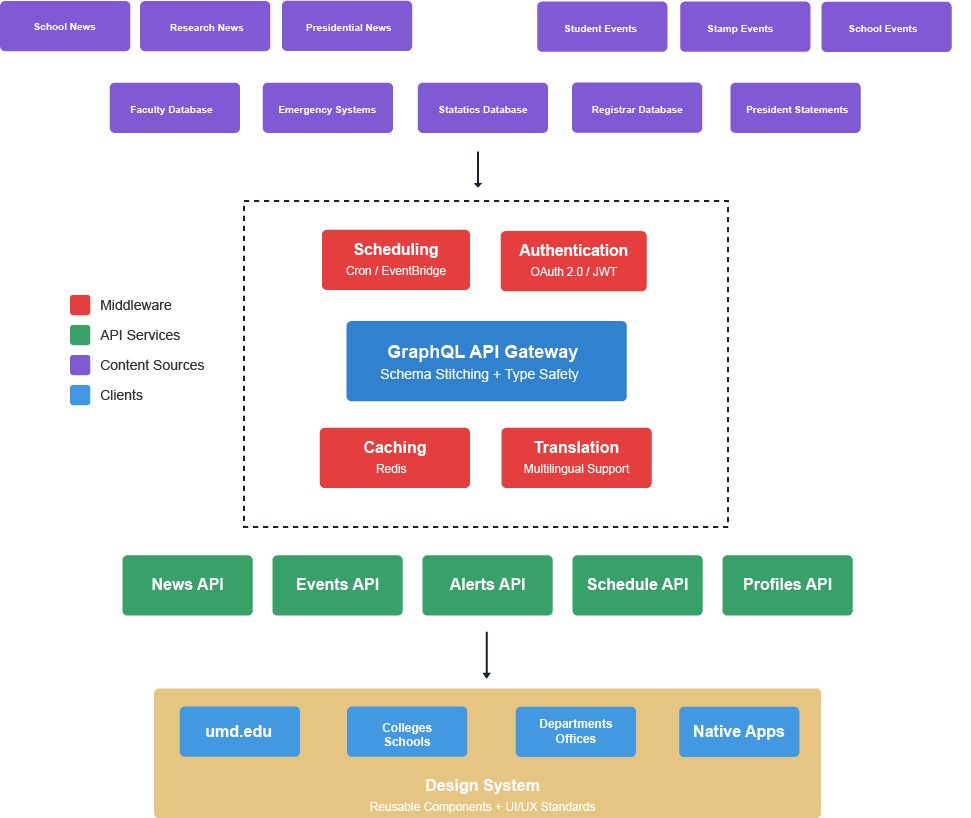
Content models stay in sync everywhere.
A YAML upstream keeps content models in sync across environments and consumers. The feed components inherit the design system’s accessibility and performance gates, so shared content arrives accessible.
Publish once, appear everywhere relevant.
The quiet half of brand alignment.
- Stop paying to publish twiceMost campuses already pay to publish the same story five times. Shared content services end that.
- Keep units in controlDepartments still own their content. They just stop copying it.
- Pair it with the systemFeeds render through the design system, so shared content looks right and stays accessible on every site.
Who did what, and where the numbers come from.
- Role
- Product owner and architect of the platform, inside UMD’s Office of Marketing and Communications.
- Sources
- magness.im/study/umd-main
- Images
- Diagram is our own.